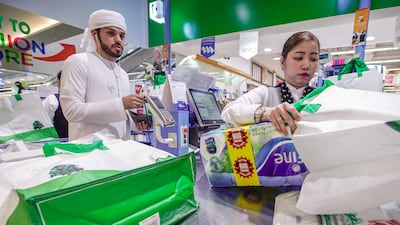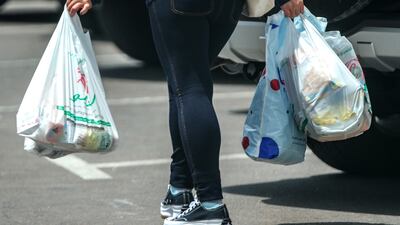
Plastic bags are already being phased out in Dubai and Abu Dhabi. Victor Besa / The National

UAE to ban single-use plastic from 2024


  • English
  • Arabic

The UAE will impose a nationwide ban on single-use plastic from next year, the government has said.

From January 1, 2024, plastic bags of any material or composition will be prohibited.

From January 1, 2026, it will be prohibited to import plastic cutlery, drinks cups, styrofoam and boxes.

The ban will include everything from “food packaging, plastic bottles, cotton sticks, crackers bags and cigarette butts … wet wipes, balloons and balloon sticks” that contain plastic.

The move will protect the environment and be of benefit to consumers, state news agency Wam said.

The government said authorities, retailers, suppliers and consumers should prepare with “suitable, sustainable and multi-use alternatives in all shopping stores, retail stores and sales outlets on a permanent basis”, the agency reported.

The federal ruling goes further than new rules last summer in Dubai, which imposed a nominal 25 fils charge on plastic bags, and in Abu Dhabi, which banned most plastic bags.

In Abu Dhabi, the June 1 ban has already led to 87 million fewer single-use plastic bags being used, a cut of about 90 per cent. Sharjah had already planned a ban on bags from January 1, 2024.

The ruling contains exceptions that include plastic bags made from recycled materials. It also includes plastics required in goods that are exported abroad.

Plastic bags are one of the most problematic kinds of waste, polluting streets and waterways and harming birds and marine life. It takes decades to degrade and microscopic particles have been found inside the bodies of fish, birds and other animals.

Last year, as the plastic charge was rolled out, Dubai officals said nine in 10 turtles and five in ten camels found dead had plastic in their stomachs.

The UAE, which will host the United Nations climate summit Cop28 in November, aims to achieve carbon neutrality by 2050.

Best long-life alternatives: in pictures

  • Cotton reusable mesh bags can be used for fruit and vegetables. Getty Images
    Cotton reusable mesh bags can be used for fruit and vegetables. Getty Images
  • Reuseable plastic bags on sale at Lulu Hypermarket are thicker and more durable than single-use ones. Victor Besa / The National
    Reuseable plastic bags on sale at Lulu Hypermarket are thicker and more durable than single-use ones. Victor Besa / The National
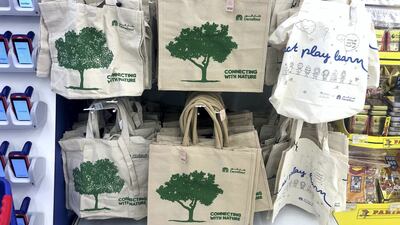
  • Reusable canvas and jute bags on display at Carrefour in Mall of the Emirates. Jute bags are one of the most durable options and are also naturally biodegradable. Canvas tote bags may not be as environmentally friendly because they require more resources to produce and distribute but can be used many times. Chris Whiteoak / The National
    Reusable canvas and jute bags on display at Carrefour in Mall of the Emirates. Jute bags are one of the most durable options and are also naturally biodegradable. Canvas tote bags may not be as environmentally friendly because they require more resources to produce and distribute but can be used many times. Chris Whiteoak / The National
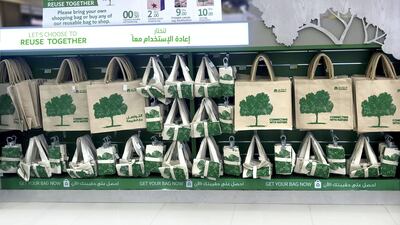
  • Carrefour is encouraging customers to bring their own recyclable bags by providing dedicated checkout counters and bonus Share points as incentives. Photo: Majid Al Futtaim
    Carrefour is encouraging customers to bring their own recyclable bags by providing dedicated checkout counters and bonus Share points as incentives. Photo: Majid Al Futtaim
  • Jute bags are both durable and biodegradable. Pawan Singh / The National
    Jute bags are both durable and biodegradable. Pawan Singh / The National
  • A customer using a trolley bag at Spinneys supermarket in Dubai Marina. Trolley bags are perfect for those walking home from the supermarket. Pawan Singh / The National
    A customer using a trolley bag at Spinneys supermarket in Dubai Marina. Trolley bags are perfect for those walking home from the supermarket. Pawan Singh / The National

Mercer, the investment consulting arm of US services company Marsh & McLennan, expects its wealth division to at least double its assets under management (AUM) in the Middle East as wealth in the region continues to grow despite economic headwinds, a company official said.

Mercer Wealth, which globally has $160 billion in AUM, plans to boost its AUM in the region to $2-$3bn in the next 2-3 years from the present $1bn, said Yasir AbuShaban, a Dubai-based principal with Mercer Wealth.

Within the next two to three years, we are looking at reaching $2 to $3 billion as a conservative estimate and we do see an opportunity to do so,” said Mr AbuShaban.

Mercer does not directly make investments, but allocates clients’ money they have discretion to, to professional asset managers. They also provide advice to clients.

“We have buying power. We can negotiate on their (client’s) behalf with asset managers to provide them lower fees than they otherwise would have to get on their own,” he added.

Mercer Wealth’s clients include sovereign wealth funds, family offices, and insurance companies among others.

From its office in Dubai, Mercer also looks after Africa, India and Turkey, where they also see opportunity for growth.

Wealth creation in Middle East and Africa (MEA) grew 8.5 per cent to $8.1 trillion last year from $7.5tn in 2015, higher than last year’s global average of 6 per cent and the second-highest growth in a region after Asia-Pacific which grew 9.9 per cent, according to consultancy Boston Consulting Group (BCG). In the region, where wealth grew just 1.9 per cent in 2015 compared with 2014, a pickup in oil prices has helped in wealth generation.

BCG is forecasting MEA wealth will rise to $12tn by 2021, growing at an annual average of 8 per cent.

Drivers of wealth generation in the region will be split evenly between new wealth creation and growth of performance of existing assets, according to BCG.

Another general trend in the region is clients’ looking for a comprehensive approach to investing, according to Mr AbuShaban.

“Institutional investors or some of the families are seeing a slowdown in the available capital they have to invest and in that sense they are looking at optimizing the way they manage their portfolios and making sure they are not investing haphazardly and different parts of their investment are working together,” said Mr AbuShaban.

Some clients also have a higher appetite for risk, given the low interest-rate environment that does not provide enough yield for some institutional investors. These clients are keen to invest in illiquid assets, such as private equity and infrastructure.

“What we have seen is a desire for higher returns in what has been a low-return environment specifically in various fixed income or bonds,” he said.

“In this environment, we have seen a de facto increase in the risk that clients are taking in things like illiquid investments, private equity investments, infrastructure and private debt, those kind of investments were higher illiquidity results in incrementally higher returns.”

The Abu Dhabi Investment Authority, one of the largest sovereign wealth funds, said in its 2016 report that has gradually increased its exposure in direct private equity and private credit transactions, mainly in Asian markets and especially in China and India. The authority’s private equity department focused on structured equities owing to “their defensive characteristics.”

Four-day collections of TOH

Day             Indian Rs (Dh)        

Thursday    500.75 million (25.23m)

Friday         280.25m (14.12m)

Saturday     220.75m (11.21m)

Sunday       170.25m (8.58m)

Total            1.19bn (59.15m)

(Figures in millions, approximate)

The details

Heard It in a Past Life

Maggie Rogers

(Capital Records)

3/5

2019 Asian Cup final

Japan v Qatar
Friday, 6pm
Zayed Sports City Stadium, Abu Dhabi

Who's who in Yemen conflict

Houthis: Iran-backed rebels who occupy Sanaa and run unrecognised government

Yemeni government: Exiled government in Aden led by eight-member Presidential Leadership Council

Southern Transitional Council: Faction in Yemeni government that seeks autonomy for the south

Habrish 'rebels': Tribal-backed forces feuding with STC over control of oil in government territory

Updated: January 11, 2023, 8:01 AM